


Professor Wu-Ken Shih Unpacks Food Politics in EMI Guest Lecture



Date :
2025-11-27
Department :
International Master's Program in International Communication Studies
【Article by College of Communication】
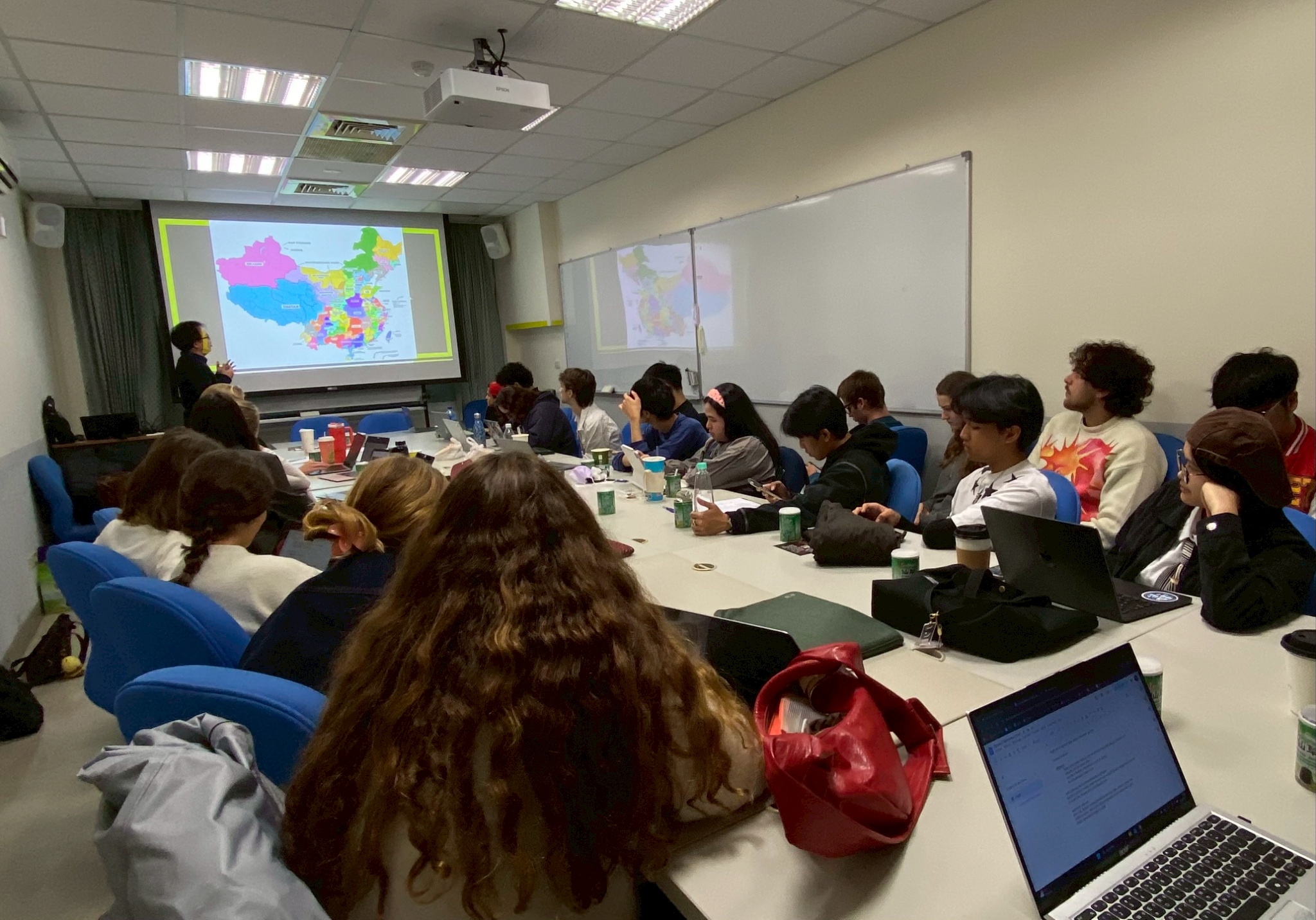
On November 19, 2025, Professor Wu-Ken Shih returned to the EMI Course of College of Communication at NCCU, to deliver a nuanced guest lecture on how food and foodways intertwine with Taiwanese history and identity development. Invited by Professor Chia-Hsin Yeh for the course “Cultural Diversity and Multilingualism in Taiwan's Media”, the talk drew on anthropological, historical, and cultural studies to show how even the mundane can be political.
Professor Shih began by tracing Taiwan's historical timeline: from indigenous to Manchurian rules (17th-19th century), Japanese colonialism (first half of the 20th century), Kuomintang’s mini-China (later half of 20th century), and the emergence of a new national consciousness in the 21st century. Thanks to thinkers like Claude Levi-Strauss, Roland Barthes, Jean-Louis Flandrin, Jack Goody, Rachel Laudan, and Pierre Bourdieu, he illustrated how food has evolved as a system of language and meaning-making. Questions such as what constitutes “high cuisine,” or how dining out differs symbolically from home cooking, become ways to understand food hierarchies and social distinctions.
Moving from history to contemporary culture, the Professor introduced Benedict Anderson’s and Eric Hobsbawm’s theories on imagined communities and invented traditions. He highlighted how national dishes and culinary customs emerge as symbolic markers of identity. For example, while tea rituals remain embedded in Taiwan’s police stations, US police officers are often stereotyped as doughnut enthusiasts - a reminder that food habits can reflect markers of class, gender, and other socio-cultural roles in different contexts.
Professor Shih then turned to modern representations of Taiwanese food, examining how marketing tools (restaurant décor, menu design, copywriting, visual branding, etc.) recast culinary legacy. Besides Austronesian taros, sweet potatoes and congee once associated with pre-WWII Han-ethnic peasants, have been transformed from humble staples to industrial products. Meanwhile, dishes like the dried radish omelette (菜脯蛋) persist largely unchanged or antiquated, serving as what Professor Shih called “a kind of living fossil.”
Concluding the lecture, he emphasised that food sits at the crossroads of heritage and innovation. During a lively Q&A session, students probed issues of authenticity, cultural appropriation versus appreciation, and the future of culinary fusion and hybridity.
The College of Communication at NCCU continues to welcome professionals from various fields to support its EMI program mission. Professor Shih's visit underscored how everyday “norms” are shaped by intersectional narratives, inviting everyone to question familiar assumptions with critical insight.
On November 19, 2025, Professor Wu-Ken Shih returned to the EMI Course of College of Communication at NCCU, to deliver a nuanced guest lecture on how food and foodways intertwine with Taiwanese history and identity development. Invited by Professor Chia-Hsin Yeh for the course “Cultural Diversity and Multilingualism in Taiwan's Media”, the talk drew on anthropological, historical, and cultural studies to show how even the mundane can be political.
Professor Shih began by tracing Taiwan's historical timeline: from indigenous to Manchurian rules (17th-19th century), Japanese colonialism (first half of the 20th century), Kuomintang’s mini-China (later half of 20th century), and the emergence of a new national consciousness in the 21st century. Thanks to thinkers like Claude Levi-Strauss, Roland Barthes, Jean-Louis Flandrin, Jack Goody, Rachel Laudan, and Pierre Bourdieu, he illustrated how food has evolved as a system of language and meaning-making. Questions such as what constitutes “high cuisine,” or how dining out differs symbolically from home cooking, become ways to understand food hierarchies and social distinctions.
Moving from history to contemporary culture, the Professor introduced Benedict Anderson’s and Eric Hobsbawm’s theories on imagined communities and invented traditions. He highlighted how national dishes and culinary customs emerge as symbolic markers of identity. For example, while tea rituals remain embedded in Taiwan’s police stations, US police officers are often stereotyped as doughnut enthusiasts - a reminder that food habits can reflect markers of class, gender, and other socio-cultural roles in different contexts.
Professor Shih then turned to modern representations of Taiwanese food, examining how marketing tools (restaurant décor, menu design, copywriting, visual branding, etc.) recast culinary legacy. Besides Austronesian taros, sweet potatoes and congee once associated with pre-WWII Han-ethnic peasants, have been transformed from humble staples to industrial products. Meanwhile, dishes like the dried radish omelette (菜脯蛋) persist largely unchanged or antiquated, serving as what Professor Shih called “a kind of living fossil.”
Concluding the lecture, he emphasised that food sits at the crossroads of heritage and innovation. During a lively Q&A session, students probed issues of authenticity, cultural appropriation versus appreciation, and the future of culinary fusion and hybridity.
The College of Communication at NCCU continues to welcome professionals from various fields to support its EMI program mission. Professor Shih's visit underscored how everyday “norms” are shaped by intersectional narratives, inviting everyone to question familiar assumptions with critical insight.