


NCCU collaborates with Taipei City Hospital through FinTech


Date :
2018-04-10
Department :
-
by Chunmin Yi (易淳敏) /
Campus Reporter
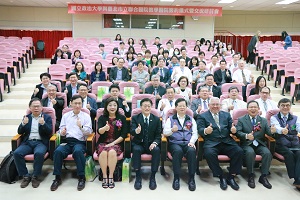
NCCU held an agreement signing ceremony with the Taipei City Hospital on March 29, expecting to build a better geriatrics and long-term care society in cooperation with the financial technology.
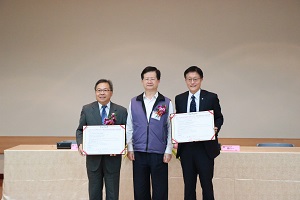
Witnessed by Huang Shier-Chieg (黃世傑), Commissioner of Department of Health, Taipei City Government, President Edward Chow (周行一) and Superintendent of the Taipei City Hospital Huang Sheng-Jean (黃勝堅) signed the agreement to enhance the collaboration between academic research and instructional internships, and to make NCCU the leader of integrating “Social Sciences and Humanities” with “Community-based Home Care Services.”
By February 2018, people aged 65 and over has already reached 440 thousand in Taipei, which makes the fast growing aging population an inevitable social issue. President Chow recalled having realized the severe insufficient social resources in long-term care before his father passed away. Since long-term care is critical and demands immediate attention, Chow further pointed out, “to create an elder-friendly society, we should not rely solely on government for solutions, but are also in need of the collaboration between public and private sectors.”
Facing the challenge of aging society, Vice President Jennifer L. Wang (王儷玲) stated the importance of the applications of AI technology. Pepper, a humanoid robot, for instance, has been serving in some medical facilities and long-term care institutions as an important alternative home care resource to solve the problems of labor shortage and to interact and accompany with the elders. Applying block chain technology in medical care and insurance can also provide more accurate analyses and diagnosis, integrate all health reports into the patient’s personal health account, and easily transfer medical records with privacy and security.
NCCU and Taipei City Hospital both have their strengths and the outcomes of their collaboration are promising, Vice President Wang said. Taipei City Hospital successfully promotes the “High Quality Health Care Services” and “Community-based Humanistic Medicare;” NCCU is the only university that receives the GLORIA project (Global Research & Industry Alliance) in FinTech from the Ministry of Science and Technology and its College of Science has already cooperated with the Taipei City Hospital in medical information management. Wang expected that through more collaboration with the Taipei City Hospital, NCCU would be able promote and extend the academic education of psychological intelligence, health care, and financial insurance to the public and to fulfill the university social responsibility (USR).
Campus Reporter
NCCU held an agreement signing ceremony with the Taipei City Hospital on March 29, expecting to build a better geriatrics and long-term care society in cooperation with the financial technology.
Witnessed by Huang Shier-Chieg (黃世傑), Commissioner of Department of Health, Taipei City Government, President Edward Chow (周行一) and Superintendent of the Taipei City Hospital Huang Sheng-Jean (黃勝堅) signed the agreement to enhance the collaboration between academic research and instructional internships, and to make NCCU the leader of integrating “Social Sciences and Humanities” with “Community-based Home Care Services.”
By February 2018, people aged 65 and over has already reached 440 thousand in Taipei, which makes the fast growing aging population an inevitable social issue. President Chow recalled having realized the severe insufficient social resources in long-term care before his father passed away. Since long-term care is critical and demands immediate attention, Chow further pointed out, “to create an elder-friendly society, we should not rely solely on government for solutions, but are also in need of the collaboration between public and private sectors.”
Facing the challenge of aging society, Vice President Jennifer L. Wang (王儷玲) stated the importance of the applications of AI technology. Pepper, a humanoid robot, for instance, has been serving in some medical facilities and long-term care institutions as an important alternative home care resource to solve the problems of labor shortage and to interact and accompany with the elders. Applying block chain technology in medical care and insurance can also provide more accurate analyses and diagnosis, integrate all health reports into the patient’s personal health account, and easily transfer medical records with privacy and security.
NCCU and Taipei City Hospital both have their strengths and the outcomes of their collaboration are promising, Vice President Wang said. Taipei City Hospital successfully promotes the “High Quality Health Care Services” and “Community-based Humanistic Medicare;” NCCU is the only university that receives the GLORIA project (Global Research & Industry Alliance) in FinTech from the Ministry of Science and Technology and its College of Science has already cooperated with the Taipei City Hospital in medical information management. Wang expected that through more collaboration with the Taipei City Hospital, NCCU would be able promote and extend the academic education of psychological intelligence, health care, and financial insurance to the public and to fulfill the university social responsibility (USR).