


Representatives of Taiwan’s Higher Education on a Journey to Enhance Dialog and Forming Partnerships in France and Belgium



Date :
2018-08-01
Department :
-
by Chris /
OIC Campus Reporter
Despite the current semester break, NCCU’s President Prof. Dr. Edward Chow’s schedule remained quite busy with the Taiwan-France Higher Education Forum in Reims and the 2018 Taiwan-Belgium Roundtable in Brussels having taken place on July 9 and July 12, respectively. Both events mark a milestone for international cooperation between Taiwan’s higher education and their European counterparts in terms of scale and scope. With over 30 representatives of different Taiwanese universities attending the two occasions, the events have significantly contributed to increase the visibility of Taiwan’s higher education abroad and have generated new channels for interesting dialogs among all present parties. While NCCU’s delegation has utilized this unique opportunity by reaching out to existing and potential new partners and through active engagement in debates on innovations in higher education, cooperation strategies and internationalization at home.
The journey of NCCU’s delegation made a start at the second Taiwan-France Higher Education Forum hosted by the University of Reims Champagne-Ardenne on July 9. The event, organized by Campus France, attracted a total of 9 Taiwanese university presidents as well as 24 vice-presidents and directors of international affairs, who were spearheaded by Mr. Andy Cheu-An Bi, the Director General of the Department of International and Cross-Strait Education of the Taiwanese Ministry of Education. Living up to the success of the first holding of the forum last year in Kaohsiung, this year’s meeting was incorporated into Campus France’s 3-day events and represents the very first time that the occasion has designated a specific segment with a focus on a single country. Hence, signaling that France places great importance on furthering and elevating its relationship and level of cooperation with Taiwan’s institutions of higher education and research.
The forum itself had been partitioned into various sessions and subtopics, commencing with an overview of the trends, policies and challenges of France and Taiwan’s Higher Education. While France sends the greatest number of international students to Taiwan among all European nations, Prof. Jean-Luc Nahel from the Conference of University Presidents explained that France’s education system does not charge staggering amounts of tuition fees to its local and international students. Instead, the necessary university funds are acquired mainly through the governmental excellence initiative and close cooperation with the industrial sector. Subsequently, Prof. Pierre Sebban from the High Council for Evaluation of Research and Higher Education (HCERES) proceeded by introducing the council’s task of evaluating research bodies, higher education institutions and scientific cooperation foundations. The thereby followed approach, according to Prof. Sebban, is not to criticize, but rather to point out the institutions’ weak spots and offering help to improve. NCCU President Prof. Edward Chow used the given opportunity to inquire about the quandary encountered by many universities with a focus on social sciences, as they appear to be disadvantaged in terms of university rankings.
Thereafter, President of the National University of Kaohsiung, Prof. Shyue-Liang Wang, provided the forum with a thorough outline of the existing problems within the Taiwanese system of higher education. He thereby included the issue of a low birthrate coupled with a too large number of universities in Taiwan, the over conformity of Taiwanese universities in terms of structure and composition, and the large amount of knowledge that is being taught yet often not applied. Ensuing Prof. Wang’s overview, four distinguished speakers discussed the issues of “Innovation in Higher Education” and “Strategies to Strengthen Partnerships and Cooperation Abroad”.
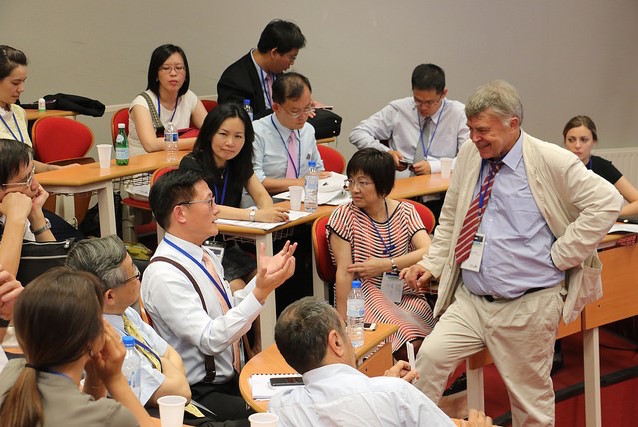
The 2018 Taiwan-Belgium Roundtable on July 12 in Brussels on the other hand has been brought into being by the Belgian Academie de Recherche et d’Enseignement Superieur (ARES). Kevin Guillaume, the Director of International Relations at ARES, had developed the idea for the event following his visit to the Foundation for International Cooperation in Higher Education of Taiwan (FICHET) last year. Discussions during the event circled around the topics of the challenges and opportunities for an internationalized higher education and research systems, while free discussions in three distinct working groups had also been organized. During the latter, President Chow served as one of the moderators and shared how NCCU is conducting internationalization at home, emphasizing on the large amount of international courses offered, NCCU’s summer school and the various activities held to connect and bring international and local students together. With an overall focus on internationalization throughout the meeting, keynote speaker Mr. Giorgio Marinoni from the International Association of Universities highlighted that student mobility still remains imbalanced and occurs predominantly in movements from the East to the West. However, he beautifully stated that internationalization is required everywhere, as it represents the cultivation of future leaders who will contribute to the society as well as to the entire globe.
Campus visits to various universities had also been arranged throughout the trip of the Taiwan delegation, including a visit to KU Leuven and the Université catholique de Louvain in Belgium, as well as to the NEOMA Business School, University of Paris-Saclay, Université PSL, and Ecole 42 (a teacher-less computer programming school) in France.
OIC Campus Reporter
Despite the current semester break, NCCU’s President Prof. Dr. Edward Chow’s schedule remained quite busy with the Taiwan-France Higher Education Forum in Reims and the 2018 Taiwan-Belgium Roundtable in Brussels having taken place on July 9 and July 12, respectively. Both events mark a milestone for international cooperation between Taiwan’s higher education and their European counterparts in terms of scale and scope. With over 30 representatives of different Taiwanese universities attending the two occasions, the events have significantly contributed to increase the visibility of Taiwan’s higher education abroad and have generated new channels for interesting dialogs among all present parties. While NCCU’s delegation has utilized this unique opportunity by reaching out to existing and potential new partners and through active engagement in debates on innovations in higher education, cooperation strategies and internationalization at home.
The journey of NCCU’s delegation made a start at the second Taiwan-France Higher Education Forum hosted by the University of Reims Champagne-Ardenne on July 9. The event, organized by Campus France, attracted a total of 9 Taiwanese university presidents as well as 24 vice-presidents and directors of international affairs, who were spearheaded by Mr. Andy Cheu-An Bi, the Director General of the Department of International and Cross-Strait Education of the Taiwanese Ministry of Education. Living up to the success of the first holding of the forum last year in Kaohsiung, this year’s meeting was incorporated into Campus France’s 3-day events and represents the very first time that the occasion has designated a specific segment with a focus on a single country. Hence, signaling that France places great importance on furthering and elevating its relationship and level of cooperation with Taiwan’s institutions of higher education and research.
The forum itself had been partitioned into various sessions and subtopics, commencing with an overview of the trends, policies and challenges of France and Taiwan’s Higher Education. While France sends the greatest number of international students to Taiwan among all European nations, Prof. Jean-Luc Nahel from the Conference of University Presidents explained that France’s education system does not charge staggering amounts of tuition fees to its local and international students. Instead, the necessary university funds are acquired mainly through the governmental excellence initiative and close cooperation with the industrial sector. Subsequently, Prof. Pierre Sebban from the High Council for Evaluation of Research and Higher Education (HCERES) proceeded by introducing the council’s task of evaluating research bodies, higher education institutions and scientific cooperation foundations. The thereby followed approach, according to Prof. Sebban, is not to criticize, but rather to point out the institutions’ weak spots and offering help to improve. NCCU President Prof. Edward Chow used the given opportunity to inquire about the quandary encountered by many universities with a focus on social sciences, as they appear to be disadvantaged in terms of university rankings.
Thereafter, President of the National University of Kaohsiung, Prof. Shyue-Liang Wang, provided the forum with a thorough outline of the existing problems within the Taiwanese system of higher education. He thereby included the issue of a low birthrate coupled with a too large number of universities in Taiwan, the over conformity of Taiwanese universities in terms of structure and composition, and the large amount of knowledge that is being taught yet often not applied. Ensuing Prof. Wang’s overview, four distinguished speakers discussed the issues of “Innovation in Higher Education” and “Strategies to Strengthen Partnerships and Cooperation Abroad”.
The 2018 Taiwan-Belgium Roundtable on July 12 in Brussels on the other hand has been brought into being by the Belgian Academie de Recherche et d’Enseignement Superieur (ARES). Kevin Guillaume, the Director of International Relations at ARES, had developed the idea for the event following his visit to the Foundation for International Cooperation in Higher Education of Taiwan (FICHET) last year. Discussions during the event circled around the topics of the challenges and opportunities for an internationalized higher education and research systems, while free discussions in three distinct working groups had also been organized. During the latter, President Chow served as one of the moderators and shared how NCCU is conducting internationalization at home, emphasizing on the large amount of international courses offered, NCCU’s summer school and the various activities held to connect and bring international and local students together. With an overall focus on internationalization throughout the meeting, keynote speaker Mr. Giorgio Marinoni from the International Association of Universities highlighted that student mobility still remains imbalanced and occurs predominantly in movements from the East to the West. However, he beautifully stated that internationalization is required everywhere, as it represents the cultivation of future leaders who will contribute to the society as well as to the entire globe.
Campus visits to various universities had also been arranged throughout the trip of the Taiwan delegation, including a visit to KU Leuven and the Université catholique de Louvain in Belgium, as well as to the NEOMA Business School, University of Paris-Saclay, Université PSL, and Ecole 42 (a teacher-less computer programming school) in France.